Archive for March 2013

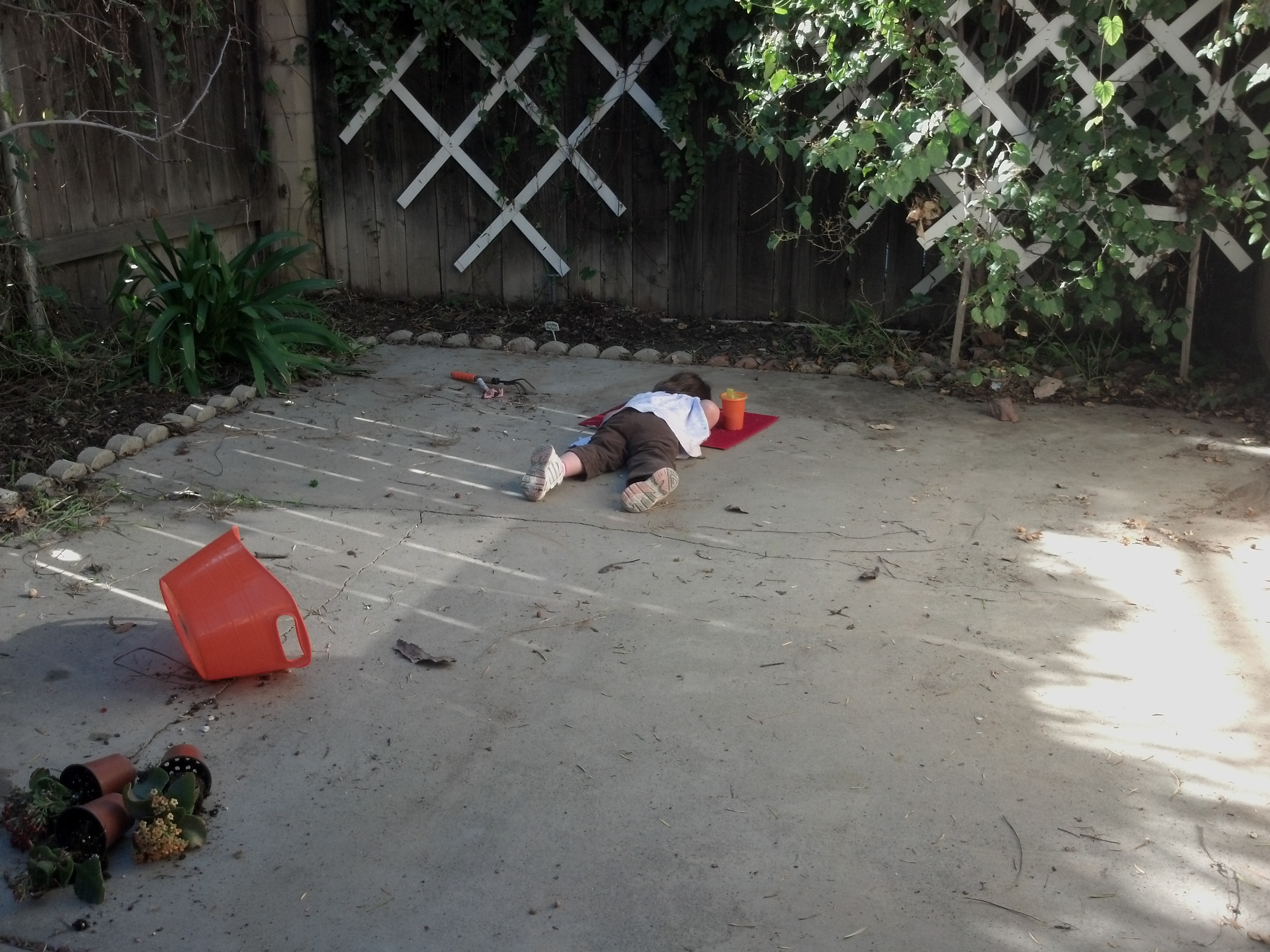
Table top
I was gone less than a minute when she disrobed, climbed on the table and opened the seeds. When I found her she said "Darla upstairs Mommy. Darla no here!"


Darla’s 2 year old doctor visit
Vitals
Temperature:
97.2
Temp source:
Tympanic
Height:
2′ 8.5" (82.6 cm)
Weight:
29 lb 8 oz (13.381 kg)
Patient instructions
Your Kaiser Permanente Care Instructions
Well Visit—24 Months: After Your Child’s Visit
Your Care Instructions
You can help your toddler through this exciting year by giving love and setting limits. Most children learn to use the toilet between ages 2 and 3. You can help your child with potty training.
Keep reading to your child. It helps his or her brain grow and strengthens your bond.
Follow-up care is a key part of your child’s treatment and safety. Be sure to make and go to all appointments, and call your doctor if your child is having problems. It’s also a good idea to know your child’s test results and keep a list of the medicines your child takes.
How can you care for your child at home?
Safety
Help prevent your child from choking by offering the right kinds of foods and watching out for choking hazards.
Watch your child at all times near the street or in a parking lot. Drivers may not be able to see small children. Know where your child is and check carefully before backing your car out of the driveway.
Watch your child at all times when he or she is near water, including pools, hot tubs, buckets, bathtubs, and toilets.
For every ride in a car, secure your child into a properly installed car seat that meets all current safety standards. For questions about car seats, call the National Highway Traffic Safety Administration at 1-888-327-4236.
Make sure your child cannot get burned. Keep hot pots, curling irons, irons, and coffee cups out of his or her reach. Put plastic plugs in all electrical sockets. Put in smoke detectors and check the batteries regularly.
Put locks or guards on all windows above the first floor. Watch your child at all times near play equipment and stairs. If your child is climbing out of his or her crib, change to a toddler bed.
Keep cleaning products and medicines in locked cabinets out of your child’s reach. Keep the number for Poison Control (1-800-222-1222) near your phone.
Tell your doctor if your child spends a lot of time in a house built before 1978. The paint could have lead in it, which can be harmful.
Give your child loving discipline
Use facial expressions and body language to show you are sad or glad about your child’s behavior. Shake your head "no," with a stern look on your face, when your toddler does something you do not like. Reward good behavior with a smile and a positive comment. ("I like how you play gently with your toys.")
Redirect your child. If your child cannot play with a toy without throwing it, put the toy away and show your child another toy.
Do not expect a child of 2 to do things he or she cannot do. Your child can learn to sit quietly for a few minutes. But a child of 2 usually cannot sit still through a long dinner in a restaurant.
Let your child do things for himself or herself (as long as it is safe). Your child may take a long time to pull off a sweater. But a child who has some freedom to try things may be less likely to say "no" and fight you.
Try to ignore some behavior that does not harm your child or others, such as whining or temper tantrums. If you react to a child’s anger, you give him or her attention for getting upset.
Time-outs
Use time-out very little. You can try time-out when your child is angry and hits, punches, bites, or kicks or has tantrums.
Choose a boring place where there are no toys or TV for time-out. The place should be safe (child-proof) and not dark or scary. Do not use bathrooms, closets, or basements. A spot on the floor, a playpen, or a chair can often be used.
Do not yell. Talk in a soft, bored tone.
If you are away from home and need to have a time-out, use the car or have your child sit on the floor or on a bench. Do not leave your child alone.
Have your child stay in time-out for 1 minute for every year of age, with a maximum of 5 minutes for time-out. Use a timer.
If your child will not stay in time-out, take him or her back quickly and reset the timer.
Some children will need to be held in time-out. You can hold his or her shoulders from behind. Tell your child that you will stop holding when he or she stays in time-out. Do not look at his or her eyes and do not do any more talking. Act like it does not bother you to be part of the time-out. If this does not work, use a bedroom with a gate that blocks the door. If you do not have a gate, hold the door closed.
Help your child learn to use the toilet
Get your child his or her own little potty, or a child-sized toilet seat that fits over a regular toilet.
Tell your child that the body makes “pee” and “poop” every day and that those things need to go into the toilet. Ask your child to “help the poop get into the toilet.”
Praise your child with hugs and kisses when he or she uses the potty. Support your child when he or she has an accident. ("That is okay. Accidents happen.")
Immunizations
Make sure that your child gets all the recommended childhood vaccines, which help keep your baby healthy and prevent the spread of disease.
What to expect at this age
Your 2-year-old’s body, mind, and emotions are growing quickly. Your child may be able to put two (and maybe three) words together. Toddlers are full of energy, and they are curious. Your child may want to open every drawer, test how things work, and often test your patience. This happens because your child wants to be independent. But he or she still wants you to give guidance.
When should you call for help?
Watch closely for changes in your child’s health, and be sure to contact your doctor if:
You are concerned that your child is not growing or developing normally.
You are worried about your child’s behavior.
You need more information about how to care for your child, or you have questions or concerns.
Where can you learn more?
Go to http://www.kp.org
Enter D662 in the search box to learn more about "Well Visit—24 Months: After Your Child’s Visit."
© 2006-2012 Healthwise, Incorporated. Care instructions adapted under license by Kaiser Permanente. This care instruction is for use with your licensed healthcare professional. If you have questions about a medical condition or this instruction, always ask your healthcare professional. Healthwise, Incorporated disclaims any warranty or liability for your use of this information.
Content Version: 9.4.94723; Last Revised: May 3, 2011
Little Changes Produce Big Rewards
Are you ready?
Every body needs a balance of nutritious foods and active living to achieve a healthy weight and prevent problems such as diabetes and heart disease. As a parent, you have the power to teach your children healthy habits that will last a lifetime.
Here are some simple steps that can bring big rewards for your family.
Eat Smart 5
Aim for 5 servings of fruits and vegetables a day
Fuel up with breakfast every morning
Pull the Plug 2
Limit screen time (TV, computers and video games) to 1-2 hours per day
Move the TV out of the bedroom
Get Moving 1
Aim for at least 60 minutes of activity a day
Escape the pull of the couch – get up and get moving
Drink Well 0
Choose water or non-fat milk
Limit soda, sports drinks, juice and sweetened drinks – one can is equal to drinking a candy bar!


 Darla's Mom